

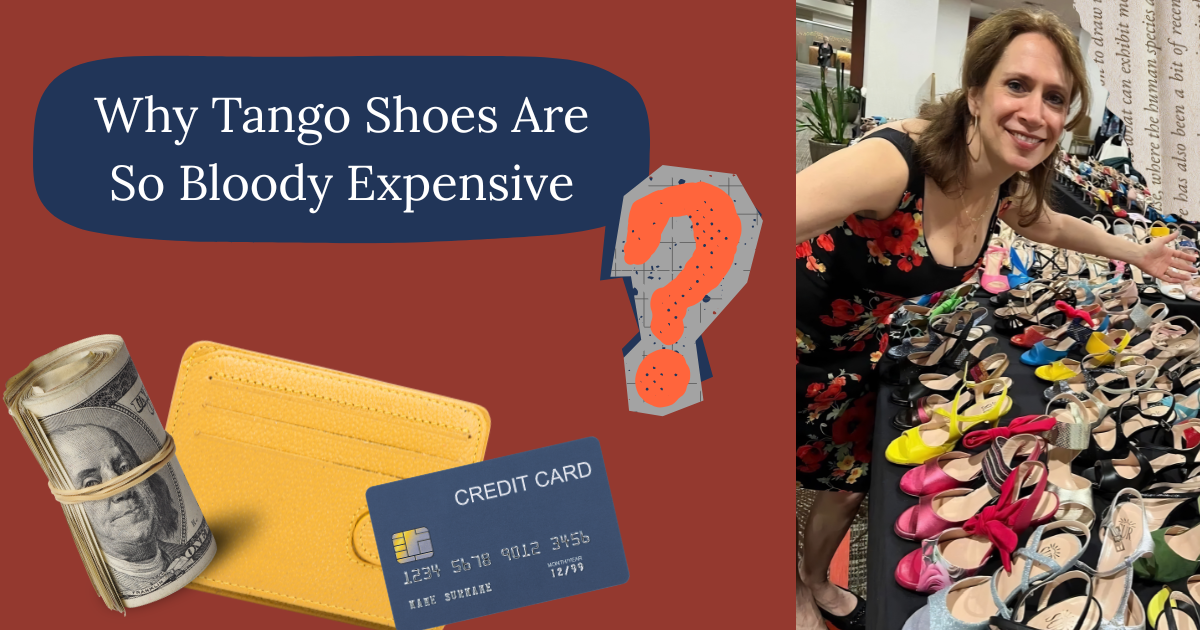
Inside the world of handcrafted heels, pivots, and intentional spending.
If you love shoes, dancing, or pretty things (or all three), you’ll understand my love of tango shoes. And yes, they’re expensive — almost $300 a pair. But they’re not “fashion heels.” They’re precision sporting equipment. Yes, that sounds like a joke, but it’s true! And when you understand what tango shoes actually do, you realize you’re strapping your feet into a tiny, elegant device calibrated to your movement. If that isn’t cool, I don’t know what is.
Now I’ve been a money coach longer than a tango dancer (30 years vs 10 years) but anyone who knows me knows I’m obsessed with all things tango. And yes, it’s not a cheap hobby– from lessons to travel to shoes. Oh the shoes!
So here’s where the money coaching comes in: This is a classic case of discerning between short‑term vs. long‑term satisfaction. Simply put, if something only gives you short‑term satisfaction, buy the cheaper version. Case-in-point: When I bought shoes recently for an outfit to attend my cousin’s wedding, I didn’t go to Nordstroms. DSW worked fine. But if something brings long‑term joy, it’s worth investing in — as long as you’ve planned for it. That’s what makes the purchase guilt‑free.
The Geeky Part: Why Tango Shoes Cost So Much
Tango shoes are handcrafted in small batches in Italy or Buenos Aires. You can’t even buy them at Nordstrom. You buy them from vendors at festivals, who function like part of a secret society whispering, “Try these… they’ll change your life.”
And they do.
The Engineering
- Steel shank: shorter and more flexible than street heels, so the shoe bends exactly where you need it to without collapsing.
- High‑quality leather upper: designed to mold to your foot over time. (Did you know we wear them barefoot so we don’t slide around in our shoes on the dance floor? Bare feet grip the leather.)
- Extra padding: because tango dancers live on the balls of their feet.
- Heel placement: centered under your weight, reinforced with nails, tango shoes pitch you slightly forward for correct tango posture. (Ballroom shoes pitch you slightly backward. And my feet still remember the pain of wearing the wrong shoes when I was a new dancer. I accidentally bought ballroom shoes.)
The Wildest Part
Tango shoes are engineered to release at 12–15 degrees of rotational force. That’s the angle where the sole and shank stop resisting and let you pivot.
- Under 10 degrees? Too stiff — your knee absorbs the torque. OUCH.
- Over 15–18 degrees? Too lose and slippery — you lose stability.
That 12–15° window is the sweet spot where the shoe holds you until you intend to pivot. As a tango salon dancer who lives on micro‑pivots and controlled dissociation (your upper and lower body often move in opposite directions in tango), this is knee‑saving magic.
A great tango shoe holds you… and then, around twelve degrees into a pivot, it releases. Suddenly your whole body flows. That’s why good shoes feel like butter.
The Festival: My Budget Meets My Dopamine
This year at Valentango — one of the biggest tango festivals in the Pacific Northwest — my top priority wasn’t dancing. It was shoes. Remember, you can’t buy them in a store.
I had budgeted $600 for two pairs. And here’s the thing people misunderstand about budgeting: Budgeting isn’t restrictive. It’s liberating. Because I had planned for this, I could plunge into the pleasure of it all without guilt or worry. My other financial goals were safe.
When we arrived, I raced to the vendor hall, determined to beat my friend Rebecca (who wears the same size, same brand, but favors a slightly higher heel — thank goodness). She was already there, of course. I dove into the tables anyway, dopamine firing like fireworks. (Scroll down for dopamine picture.)
I found a promising pair that Rebecca had just put back and waved over my dance partner (and husband) Robert, to lead me in a few pivots. When you dance intensely in heels, there is no margin for error. A bad shoe ends your night — and you have a week of blisters. A good shoe must still be broken in slowly, but it makes you feel grounded, powerful, and ready to fly.
Tango has taken me on the full emotional roller coaster — tears, bliss, peak experiences. When it works, it’s the ultimate feel‑good feeling. And the right shoes help make that possible.
After careful deliberation, I came home with two pairs. Did I want three? Yes. But 2 worked in my plan. Long‑term satisfaction achieved. Many great nights of dancing await.
The Money Takeaway
Intentional spending is not about deprivation. It’s about choosing joy on purpose. I often tell my clients, “You can do anything you want, but you can’t do everything you want. So, what do you really want?” When you budget for what you love — whether it’s tango shoes, travel, or something entirely different — you get to savor the experience fully, knowing you’re honoring both your present self and your future self.
That’s the real luxury.
Take Way Tip:
The next time you are debating a purchase, ask “Will this give me short- or long-term satisfaction?” If short, then buy the cheap version or the knock off. If long term, go for quality.
This article is also featured on Mikelann’s Substack, “Love. Money. Tango.” To view or subscribe, click here.